
.png)
.png)
ENG


For a digital document to be archived long-term, made accessible, and reliably retrievable even after many years, it needs a unique and stable identifier. This is precisely the purpose of CZIDLO – the Czech System for Identification and Localization of Digital Documents. It is a tool supporting the national permanent identification system based on the URN:NBN standard.
CZIDLO helps ensure that digital objects do not lose their findability, even if their original URL address, presentation system, or the institution's technical infrastructure changes. The identifier remains the same, while the system takes care of linking it to the document's current location.
In the environment of digital libraries and long-term archiving, it's not enough to just have files, metadata, and a presentation interface. Every digital object must be uniquely identifiable and retrievable.
Without a stable identifier, the long-term availability of a document can be fragile. A URL address can change, a system can undergo migration, and data can be moved to another repository. However, a permanent identifier remains and serves as a fixed point to which other systems can link.
CZIDLO therefore plays an important role in the entire lifecycle of a digital document – from digitization through archiving to making it accessible to users.
CZIDLO supports both automated and manual assignment of URN identifiers. Users can obtain identifiers via API or through a web interface, depending on which workflow suits their operations.
The system enables:
The system also includes resolver, which is a redirection service. It allows users, after entering an identifier, to access the current location of a document or its record, even if the original address has changed over time.

Based on internal meetings and a Figma design, we prepared a new workflow and a clearer user interface. The goal was not to create another complex system where users would get lost, but rather a tool that can handle large volumes of data while remaining intuitive for daily operations.
“UX/UI design is based on best practices and user needs. That's why we iterated and tested the design with them.” – Helena Kočnar, Lead Designer
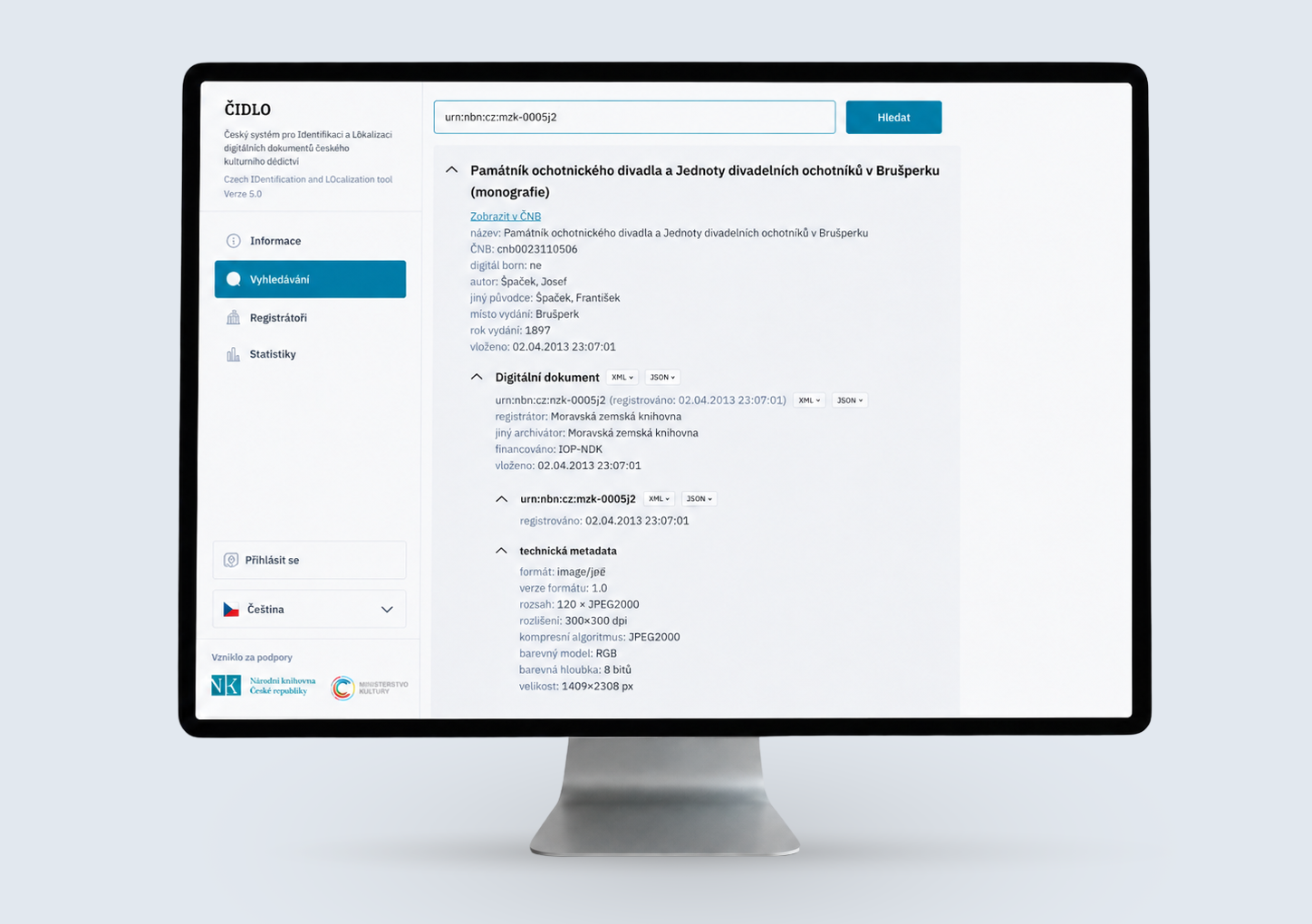
The search function is designed so that users can quickly find a specific identifier, check its metadata, and immediately perform the necessary action.
From the list of results, users can navigate to the record details, edit data, add an instance, or deactivate a record if the digitized item is incorrect. The focus is on handling large datasets, ensuring the system performs well even for institutions managing extensive digital collections.
CZIDLO works with registrars, i.e., institutions authorized to assign identifiers. These typically include libraries, digitization centers, and other participating organizations.
Each registrar can have its own prefix, assigned rights, and an overview of its records. Administrators can manage registrar data, set user permissions, and work with statistics or exports for both internal and annual reports.
The record entry form is designed to match the actual workflow of registrars. Users fill in basic metadata, add the URL, and the system helps detect errors even before saving.
URL validation reduces the risk of broken links and supports data quality right from the entry stage. This is especially important in operations where a large number of documents are processed, as minor errors could otherwise easily propagate to subsequent systems.
Administrators can create, edit, and deactivate user accounts. A regular registrar only sees their own records, while a super administrator has access to the entire system.
This allows for secure and transparent operations across multiple institutions, teams, and levels of responsibility.
CZIDLO also supports working with processes and logs. Users can initiate bulk imports or exports, monitor process progress, and track the history of changes.
Logs help verify what happened to an identifier retrospectively – from its reservation and URL assignment to subsequent modifications. This is crucial not only for technical control but also for trust in the entire system.
Statistics help both registrars and the National Library monitor system usage and plan future work with digital documents.
Data can be filtered by registrar, period, or record type, and then exported for internal evaluation, annual reports, or further reporting.

CZIDLO is primarily designed for digital libraries, digitization centers, and institutions that manage digital documents long-term.
The principle of persistent identifiers is also applicable in other memory institutions, such as archives, museums, galleries, or research organizations. In all these areas, it helps ensure that digital objects remain discoverable long-term, regardless of changes in systems or data location.
A similar approach makes sense, for example, in managing research data, technical documentation, corporate archives, or educational materials. Stable identifiers help maintain data order and ensure their reliable availability over time.
CZIDLO's development is based on open technologies and standards. Documentation and installation packages are publicly available. Users have access to documentation, a wiki, repositories, and an issue tracker for reporting bugs or suggestions.
This aligns with a long-term direction that is important for memory institutions: openness, transparency, and the ability to connect with other systems.
We collaborated on the project with the National Library of the Czech Republic, which provides expert background, methodology, and practical experience from digitization projects.
Trinera contributes technical design, development, UX/UI design, and experience with tools for data management, control, and access to the project. This results in a system that is a practical tool for people who work with identifiers and digital documents every day.
CZIDLO thus helps address one of the fundamental prerequisites for long-term digitization: ensuring that digital documents are not just created and stored, but remain reliably discoverable, linkable, and usable in the future.
The tool is publicly available to a limited extent without login at www.resolver.nkp.cz. Will you use this or a similar tool in your institution? Let us know.


