Projects that help institutions work smarter with data
From digital libraries and analytical tools to AI solutions. See how, together with our partners, we are simplifying data management and making cultural heritage more accessible.
stamp-icon
30+
participating institutions
code-icon
15+ let
software development
book-icon
15+ let
library know-how
graph-icon
100 000 000+
processed objects
software-icon
20+
software products
Our project topics
AI & development
data and metadata
analytical tools
digital libraries
UX/UI design
collection accessibility
digitization tools
process automation
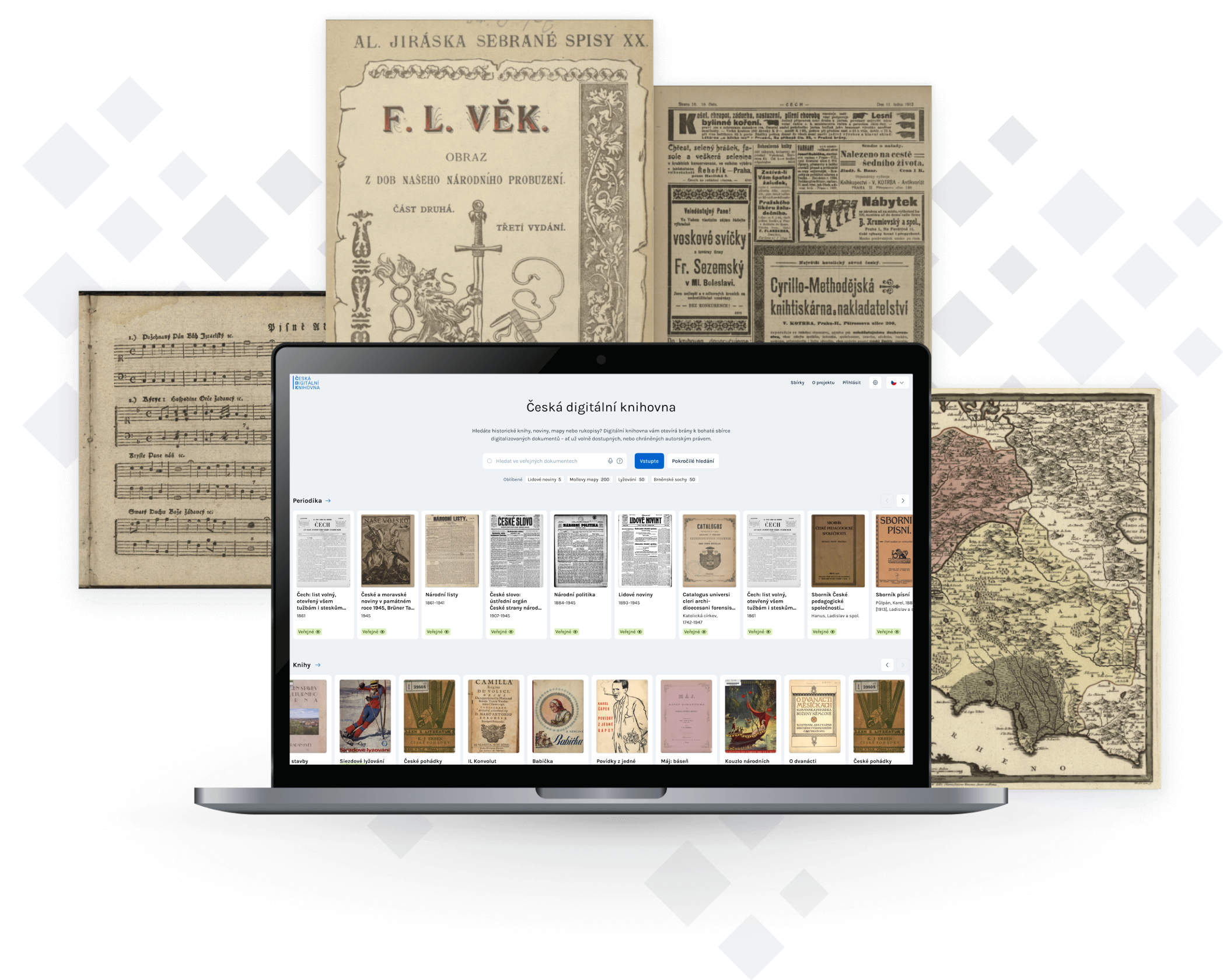
Digital library Kramerius
A modern system for libraries, archives and other memory institutions that has been making cultural heritage accessible to the general public for more than two decades.

It offers users intuitive browsing of digitized books, newspapers, maps, sheet music and other documents, convenient navigation through historical editions, and advanced search, including full-text search across content.

Continuous development and AI integration bring new possibilities for working with digital collections, such as semantic search based on the meaning of text, searching for similar images and documents, automatic translations, text-to-speech, and article summarization.

The system is also linked to the new Czech Digital Library project (ČDK), which will connect the collections of dozens of institutions in one shared environment.
book-icon
40+
libraries
stamp-icon
150 000 000+
pages
code-icon
100 000+
users/month
Learn more
arrow-right
Kramerius-visualization
Anakon-visualization
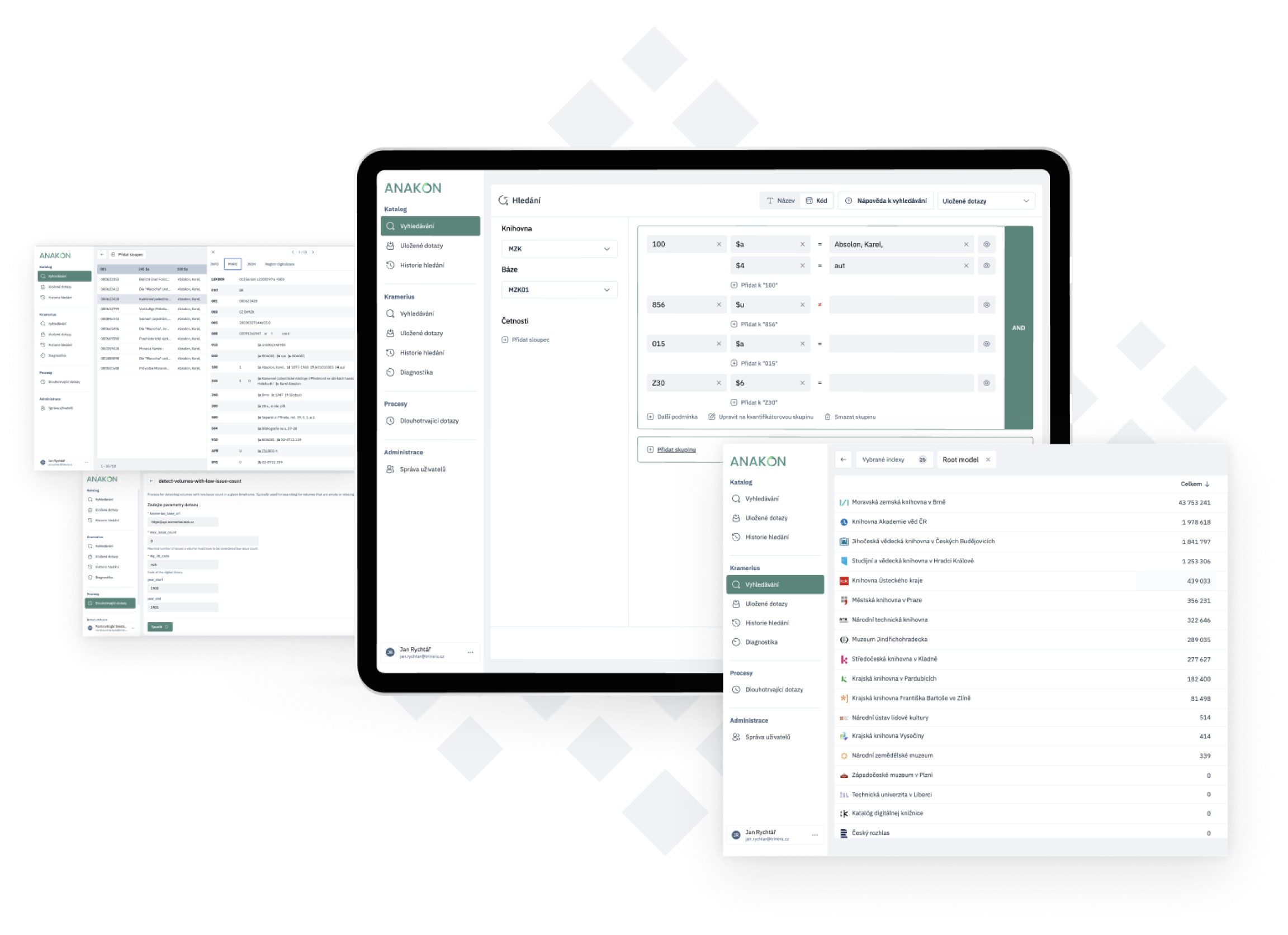
Anakon: A tool for the analysis and control of complex data
Anakon is an analytical and control tool that enables librarians to work independently with metadata in MARC 21, MODS, and Kramerius 7 index formats. It allows for advanced record filtering and, above all, systematic and efficient data handling, without programming knowledge or the need for IT department intervention.

The tool also includes diagnostics and analytics for Kramerius – the diagnostic module can identify issues such as empty titles or invalid UUIDs.
Anakon enables:
Advanced querying of catalog data without programming knowledge.
Filtering records based on logical conditions or text patterns.
Data analysis across one or multiple digital libraries simultaneously.
Data comparison between the catalog and Kramerius.
Diagnostics of typical digital library issues.
Visualization and export of results for further processing.
Anakon does not replace a traditional cataloging system and does not allow for direct record corrections. Its main benefit is not replacing existing systems, but strengthening the role of the librarian as an expert who maintains a complete overview of their data.
book-icon
35+
digital libraries
stamp-icon
15+
diagnostics
code-icon
18 000 000+
MARC 21 records
Learn more
arrow-right
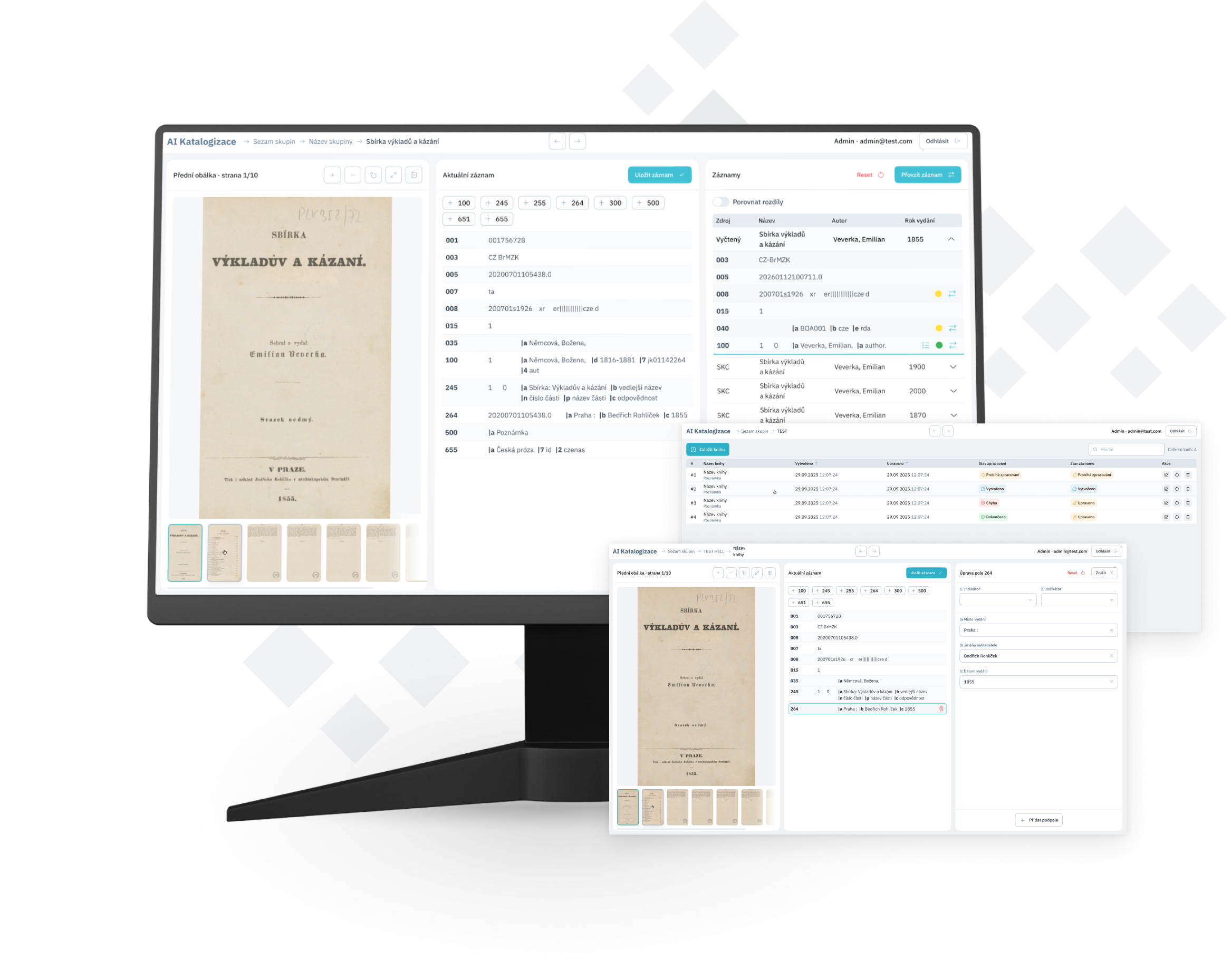
AI Cataloging
A smart cataloger's copilot that uses artificial intelligence to help create bibliographic records faster and more accurately from photographs of the title page and colophon of printed documents. It is not a black box that generates MARC21 records without oversight, but a well-thought-out chain of precisely defined steps.

The system extracts bibliographic data from the document photographs, normalizes it, looks up authorities, compares existing records in catalogs, and prepares a draft bibliographic record. It retrieves critical data from authority databases and cataloging sources, not directly from the language model. The cataloger thus maintains control over the entire process, can choose between variants, and edit the final record.

AI cataloging thus integrates AI with library practice in a way that is reliable and practically usable. The solution also includes a modern web-based MARC 21 editor that can be configured according to the needs of a specific institution.
book-icon
10+
catalogues
stamp-icon
1 000+
records
code-icon
18
auto MARC fields
Learn more
arrow-right
AI-katalogizace-visualization
Kramerius-visualization
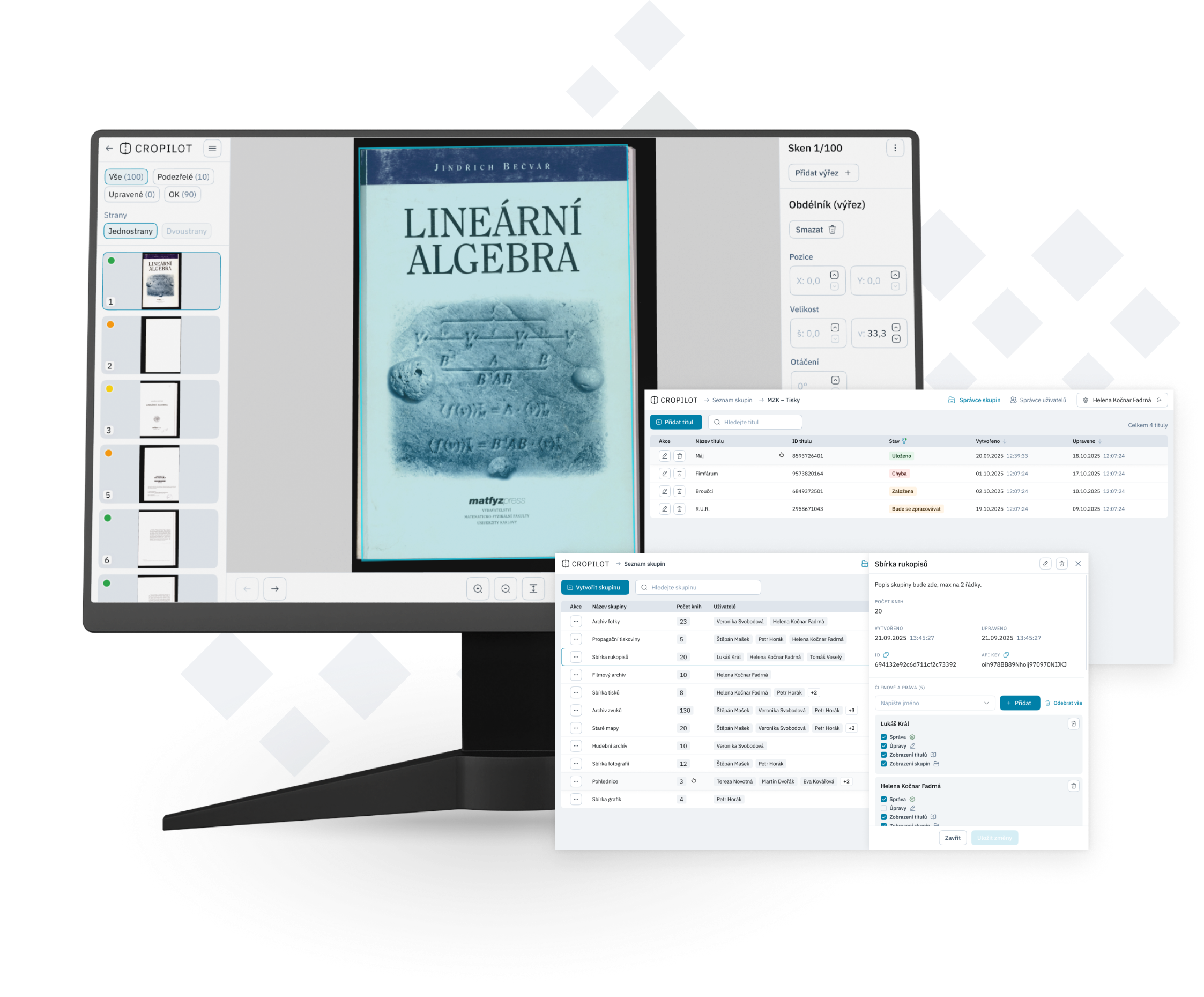
Cropilot: Automating scan cropping with AI
Cropilot is a system for fully automated scan cropping using artificial intelligence. It removes the biggest bottleneck in digitization workflows — repetitive manual page cropping. In our solution, this step is handled by an advanced AI vision model which, after additional training, can also deal with documents in very poor condition or with atypical cropping formats.
Main benefits:
Customization of cropping parameters tailored specifically to a particular collection or institution.
Minimal need for manual inspection (full automation, including page rotation and separation).
Increased digitization capacity without staff or cost growth thanks to process automation.
Stable and consistent output quality.
Continuous improvement based on feedback.
The system can be integrated into digitization lines (NDK, ProArc), incorporated into existing workflows, or used as a standalone solution.samostatné řešení.
book-icon
10+
AI models
stamp-icon
270+
scans/min
code-icon
3
institution
Learn more
arrow-right
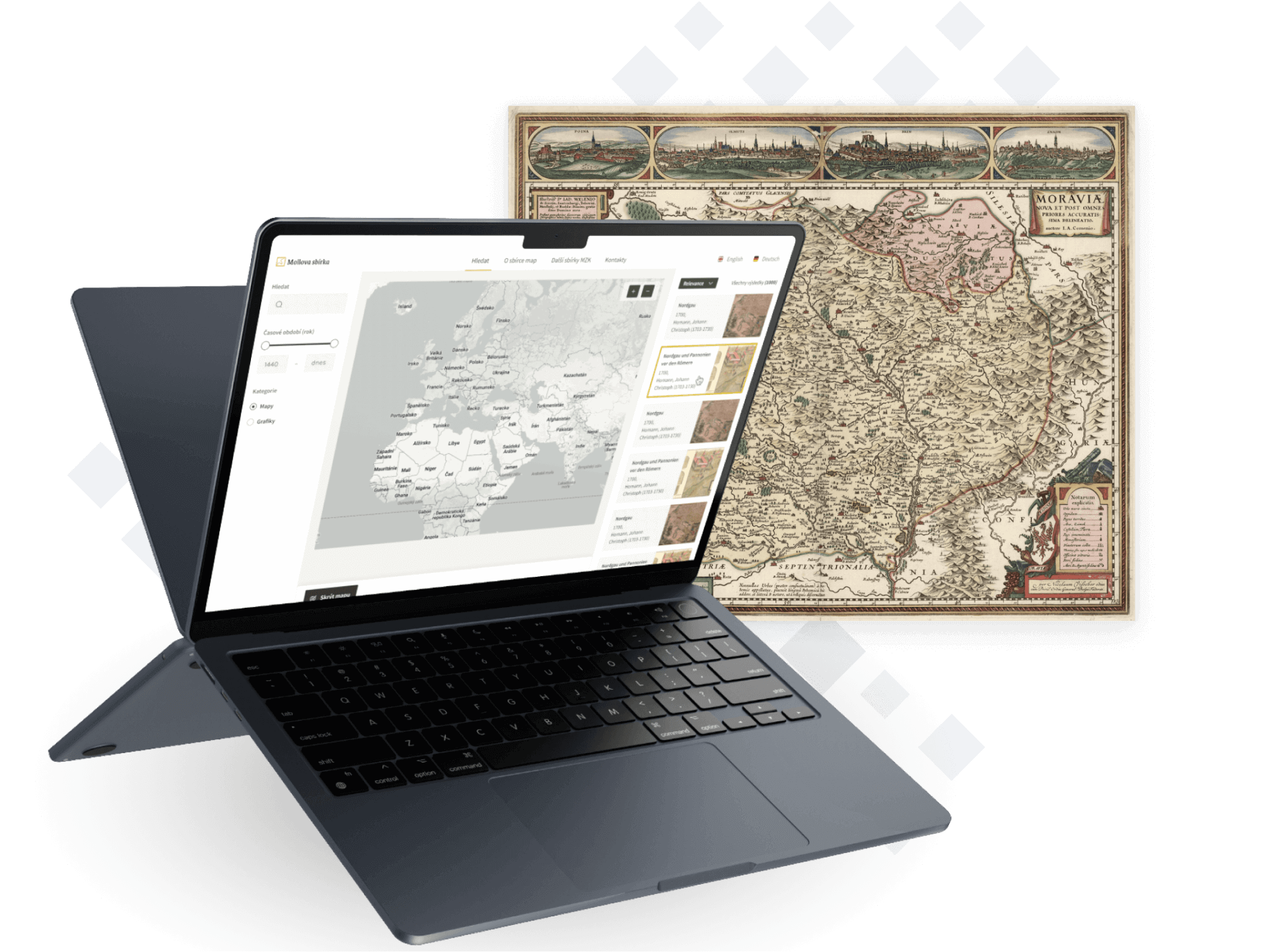
The Moll Collection of rare maps
Collection is a unique set of digitized maps and graphics from the 18th century, inscribed on the UNESCO list. To make it accessible, we have developed an interactive web presentation that reflects the unique composition of the collection and allows for clear searching across the entire digitized collection.

The user-friendly, high-resolution interface enables the detailed display of maps, including the smallest cartographic elements, browsing the collection by its historical division into regions, or searching based on territorial affiliation, author, or time period.

The Moll Collection serves as a reference solution for the digital presentation of extensive collections where visual detail and territorial, historical, or thematic context play a key role. The web application thus functions not only as a means of making collections accessible to the public, but also as a tool for professional research without the risk of damaging the originals.
book-icon
5 000
maps
stamp-icon
7 000
vedute
code-icon
16.-18.
century
Kramerius-visualization
More references
Satisfied Partners
"Trinera develops tools for us to analyze digital library traffic, validate metadata, or identify and locate digital documents. We greatly appreciate their deep knowledge of the entire digital library ecosystem and digitization processes. This allows them not only to efficiently process and interpret data, but also to proactively identify potential gaps and suggest concrete improvements."
Kukac photo
Ing. Petr Kukač
Director of Digitization and Library Systems
NK logo
"We are collaborating with Trinera on the development of the user interface of the open source system for the Kramerius digital library. I particularly appreciate the above-standard ability to sensitively analyze requirements and create interfaces that are very well received by users when using digital libraries. I also positively evaluate the company's approach with regard to orientation in the latest technologies, including AI, and their deployment in development."
Lhotak photo
Ing. Martin Lhoták
Deputy Director for R&D and Technology, Library of the CAS; Coordinator of the Kramerius System Development
KAV logo
"We have been working with Trinera for a long time on the development of digital services and the implementation of modern technological solutions. Thanks to their experience in the library environment, they understand the needs of librarians and readers and are able to reflect them in the design of functions and the user interface. I appreciate not only the technical expertise in the cooperation, but also the emphasis on practicality and user-friendliness."
Zabicka photo
Ing. Petr Žabička
Director of Research and Development
MZK logo
Do you have an idea or project to discuss?
Feel free to call or write to me.
Jan photo
Jan Rychtář
CEO
+420 725 523 666
Call on weekdays, 7 AM–5 PM
We will contact you within 2 business days.
Thank you! Your message has been received.

We will contact you within 2 business days.

We’re sorry, your message couldn’t be sent.
Please try again later.