
.png)
.png)
ENG


Divadelní fundus JAMU is a web application that provides access to the university's inventory of costumes, props, theatre equipment, musical instruments, and other aids for loan. It allows students and staff to quickly find out what is available, view item details, and make a reservation.
The goal was not to create another isolated database, but a practical interface built upon data that JAMU already uses. Trinera therefore designed and delivered a front-end connected to Airtable, so that students wouldn't have to navigate internal spreadsheets, and administrators could continue using a tool they are familiar with from their daily operations. In Airtable, they can record items, availability, contacts, locations, and operational changes.
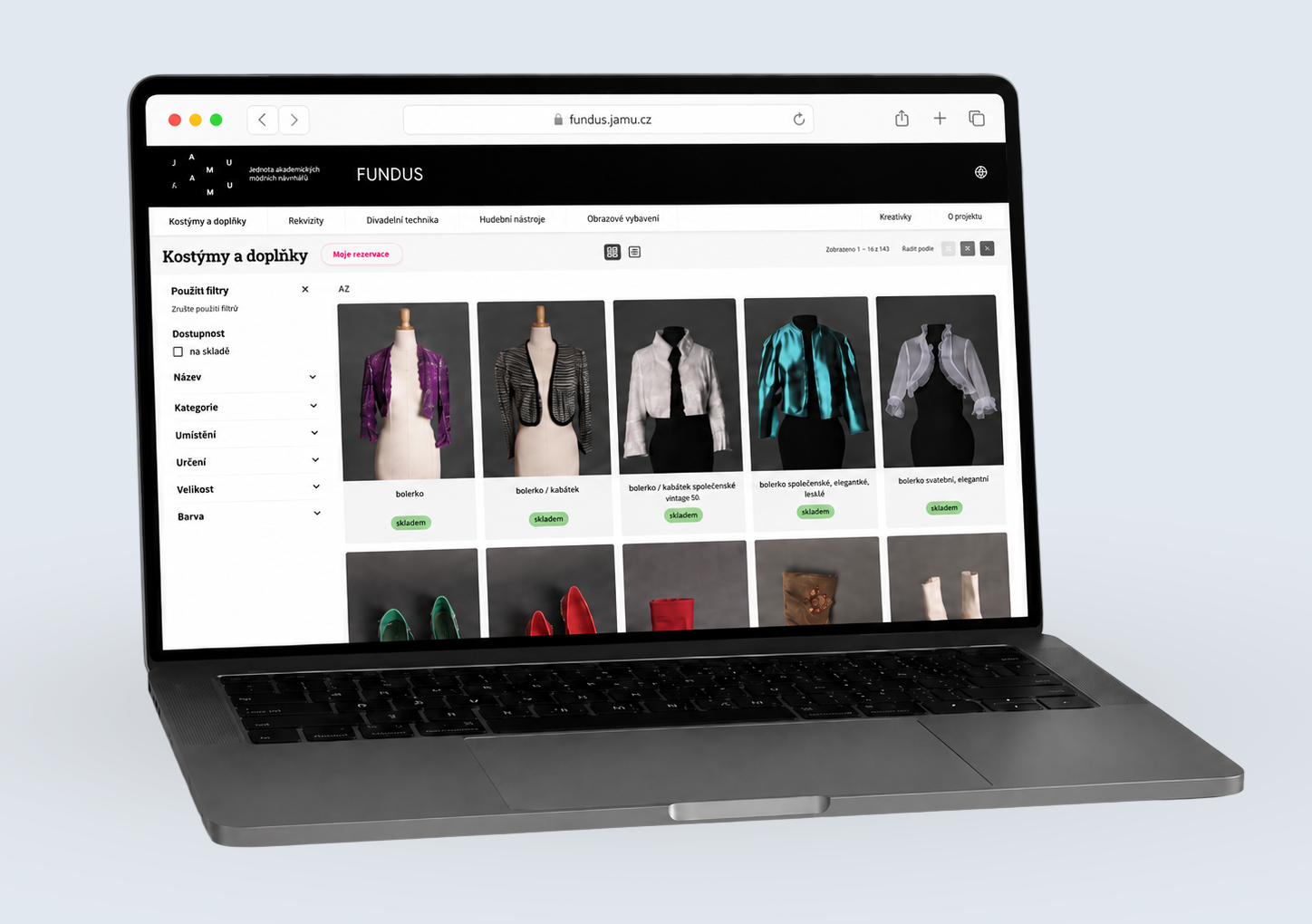
The Divadelní fundus JAMU works with a diverse inventory, including items with different data structures and usage methods. A costume requires different information than a musical instrument or theatre equipment.
For some items, a photograph, size, color, and location are important, while for others, a technical description, availability, or connection to a specific department is more relevant.
The application therefore divides the inventory into separate sections, such as:
Users can browse items in a visual grid with photos or in a table view where quick orientation by name, category, or location is more practical.
An important part of the solution is searching and filtering. Users do not need to know the exact item name or its storage location. They can progressively narrow down their selection using available parameters, work with categories, and display only items currently in stock.

The inventory system serves not just as a catalog. It is designed as an operational tool that helps manage reservations and loans within the school environment. A student or staff member can reserve a selected item via their school email, with pickup details linked to the contact information of individual storage facilities and departments.
Item management remains with the administrators. This is crucial because the inventory is not a static collection. Items are added, moved, retired, loaned out, and returned. The application therefore also accounts for the fact that some records should only be visible internally in the database but not displayed on the website.
The solution also includes the ability to operationally enable or disable reservations, for example, during periods when items are not being loaned out. This allows the tool to adapt to the rhythm of the school and individual departments, rather than forcing them to change established workflows.
From a technical perspective, the key was connecting the front-end to Airtable via a backend layer, ensuring secure data access. Trinera addressed not only the user interface itself but also data structure, API limits, filtering, item availability, and how to convert existing records into a usable web catalog.
Data consistency also played a significant role. With an extensive collection, it quickly becomes apparent that the quality of the user interface depends on how well items are described and how consistently values are used across different fields. Therefore, part of the work involved considering the structure of the inventory, loans, people, auxiliary registers, and future scalability.
The result is a solution that connects two needs:
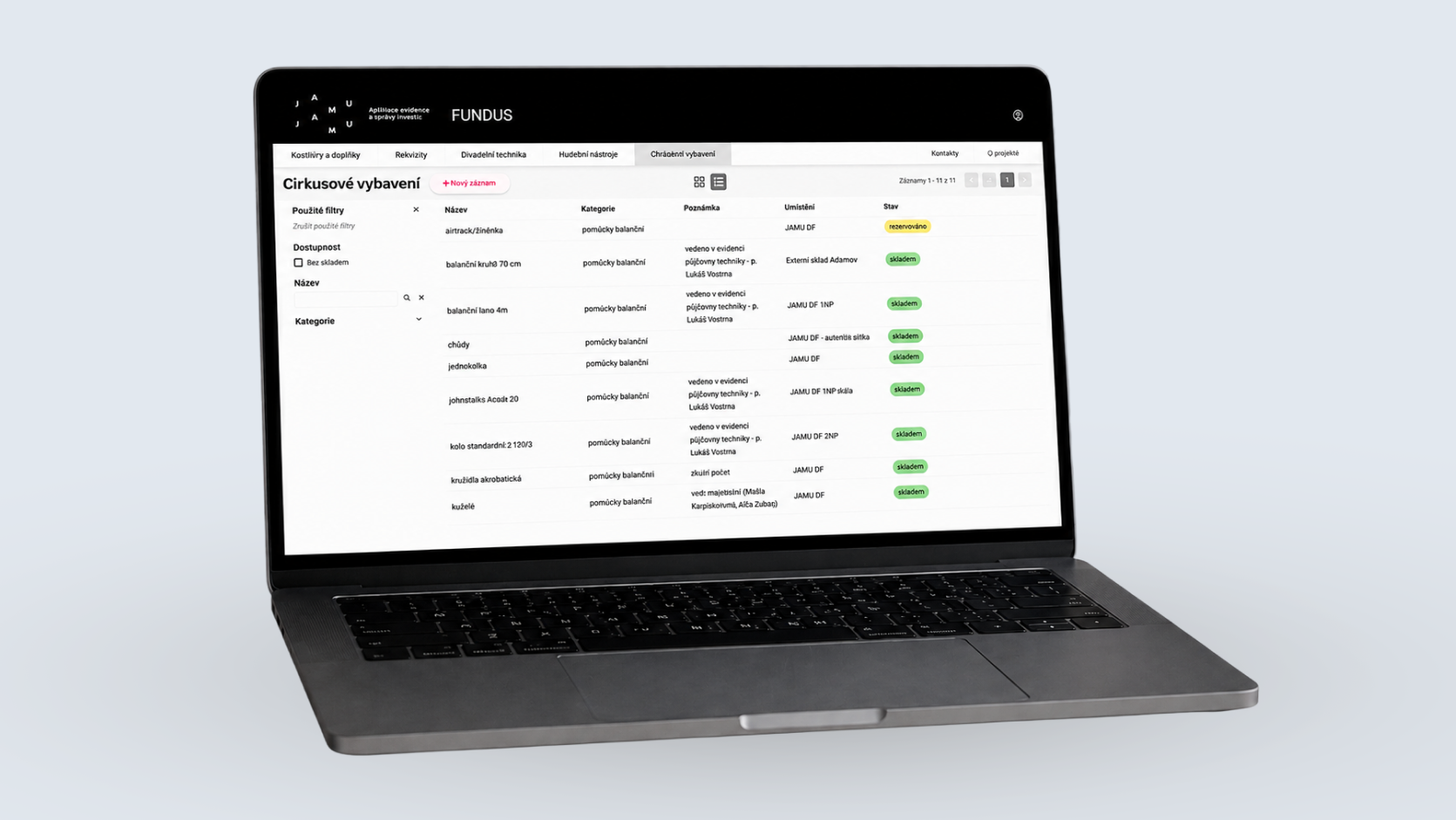
The application is designed for JAMU's internal operations, and its use is tied to the accounts of authorized users. It is publicly available at fundus.jamu.cz.
Divadelní fundus JAMU's collection is primarily intended for the school's students and staff, who need to work with physical items spread across multiple warehouses and workplaces.
It offers the greatest benefit in environments with extensive inventory, multiple administrators, various item types, and regular loan operations.
The principle of this solution is transferable to other organizations that need to manage collections, funds, or loans clearly. Museums, galleries, archives, or libraries often manage collections that are not only for public presentation but also for internal work, research requests, loans, exhibitions, or operational records.
A similar interface can make collection items accessible to curators, record the availability of exhibition elements, facilitate work with photographs, and integrate the catalog with internal workflows.
It also has applications outside the cultural sector.
They all face a very similar question: how to make inventory accessible to the people who need to use it, while maintaining control over records, accountability, and availability.
The theatre inventory thus shows that a well-designed catalog doesn't have to be just a passive list of items. It can be a practical operational tool that saves administrators time, simplifies navigation for users, and helps the institution better utilize the resources it already possesses.
Would a similar reservation system make sense for your institution? Let us know.


